Erik the Swift
A fast Viking who runs and jumps, including a double jump.
How it plays
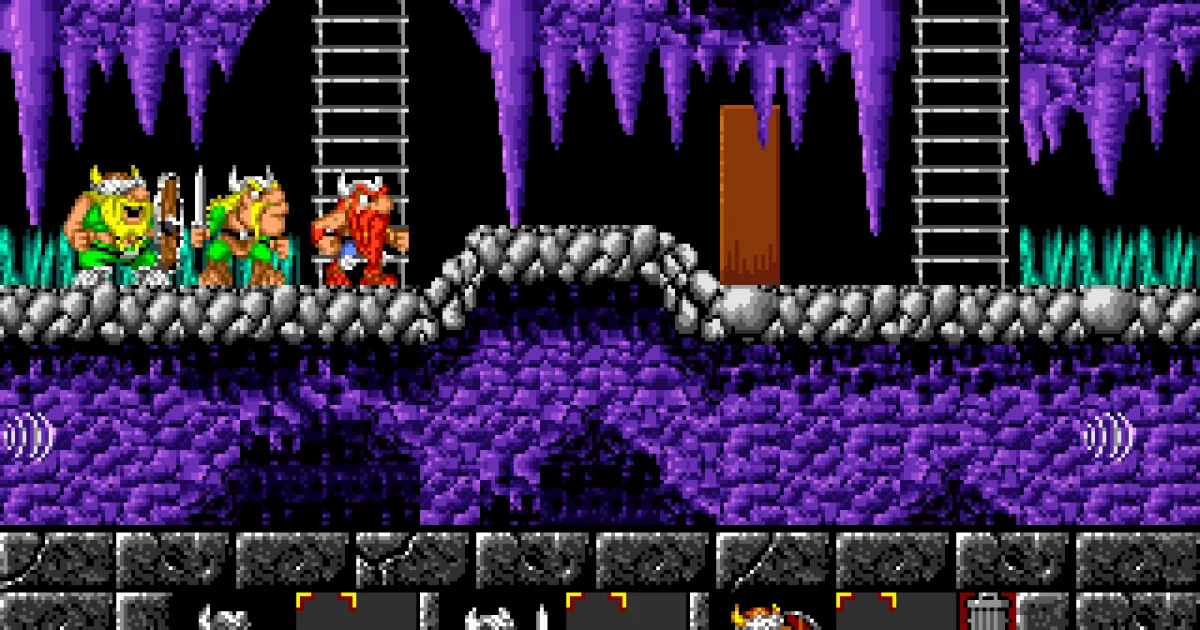
The game uses a side-scrolling perspective. Players guide a small team through self-contained stages, switching between characters to overcome hazards, activate mechanisms, defeat enemies, and reach the exit.
Erik runs and jumps, Baleog uses weapons, Olaf blocks attacks and glides with his shield, Fang fights with martial-arts moves, and Scorch breathes fire. Stages require careful sequencing because a character can often prepare a route or mechanism for another. Progression comes from completing successive stages and learning how the five abilities interact.
Plan your run
Study the entire screen before committing to a move. Identify which character can safely reach each switch, enemy, or platform, then perform actions in an order that prevents the team from becoming separated.
Use Olaf’s shield for controlled protection and gliding, Erik’s jumping ability for vertical routes, and Baleog, Fang, or Scorch to remove threats. If a puzzle seems impossible, look for a required ability rather than attempting to force the obstacle.
Meet the cast
A fast Viking who runs and jumps, including a double jump.
A Viking fighter who attacks with a sword and ranged weapons.
A defensive Viking whose shield blocks hazards and supports gliding.
A martial-arts fighter who uses acrobatic attacks and mobility.
A dragon-like ally who attacks with fire.
An alien-like antagonist whose actions set the adventure in motion.
Before you begin
Switch characters frequently; many obstacles are designed around combining two or more abilities.
Keep vulnerable characters away from hazards while another character activates a mechanism.
The Lost Vikings 2 is a puzzle-platform adventure developed by Blizzard Entertainment and published by Interplay Productions for DOS in 1997. It follows three returning Vikings and two new allies as they attempt to escape another dangerous situation involving time travel and hostile worlds. The game combines side-scrolling exploration, environmental puzzles, light action, and character switching. Each hero has abilities that solve different parts of a stage, so progress depends on cooperation rather than simple combat. The sequel was generally recognized for expanding the original formula with more characters, varied settings, and inventive puzzles.
Catalog entry maintained by EmuGamers Editorial Team
Community discussion
What are players saying? 0