
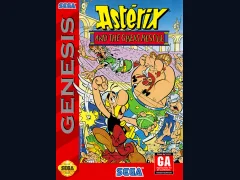
Asterix and the Great Rescue
Sega GenesisPlatformer
Documented for this version
D-pad Left | Lean and steer left |
|---|---|
D-pad Right | Lean and steer right |
A | Accelerate |
B | Brake |
The Genesis version supports automatic and manual transmission options.
Button assignments can vary by regional manual or controller setup.
How it plays
The game uses a third-person camera positioned behind the motorcycle. The objective is to reach successive checkpoints before time expires; passing checkpoints adds time and allows the ride to continue.
Players steer by leaning left or right, accelerate on straights, brake for traffic and bends, and choose between automatic and manual transmission where available. Courses are organized by route and difficulty rather than a traditional season. Completing longer routes and improving checkpoint performance provide the main form of progression.
Plan your run
Brake before a turn instead of entering it at maximum speed. Smooth steering preserves momentum and reduces the chance of drifting into traffic or roadside barriers.
Learn the route landmarks and use the straight sections to recover speed. In manual transmission mode, select a lower gear before tight bends and shift up only after the bike is stable.
Prioritize reaching every checkpoint safely. A clean run with modest speed is more valuable than a risky attempt that loses several seconds in a collision.
Before you begin
Use the full width of the road to set up wide turns.
Avoid unnecessary braking on gentle bends.
Practice one route repeatedly to memorize traffic and corner timing.
Super Hang-On is an arcade motorcycle-racing game developed by Sega AM2 and released for the Sega Genesis in 1989. It is the follow-up to Hang-On, presenting a fast, checkpoint-based ride across long international courses. The player controls a single superbike, leans through sweeping turns, avoids traffic, and races against a countdown clock rather than competing in a conventional lap championship. The Genesis version adapts the arcade game's distinctive behind-the-rider perspective and route-based structure to home play. Its selectable courses, adjustable difficulty, music, and manual or automatic transmission give the short sessions some variety. Reception generally recognized its speed and faithful arcade character, while noting that the home hardware could not completely reproduce the scale and visual smoothness of the arcade original.
Catalog entry maintained by EmuGamers Editorial Team



Community discussion
What are players saying? 0