
Donkey Kong Jr.
The playable young ape who climbs through dangerous stages to rescue his imprisoned father.
Documented for this version
Joystick | Move left or right and climb vines or chains |
|---|---|
Jump Button | Jump over hazards |
The exact physical button label can vary between arcade cabinets.
Controls describe the original arcade version.
How it plays
Donkey Kong Jr. is played from a side-view perspective across four fixed arcade stages. The objective is to reach and unlock the cages holding Donkey Kong while avoiding enemies, falling hazards, and moving obstacles.
The joystick moves Jr. horizontally and lets him climb vines and chains; the jump button is used to clear hazards. Players must collect keys, choose safe climbing routes, and time movements around Snapjaws, birds, sparks, and other stage-specific threats. After the fourth stage, the sequence repeats at higher difficulty.
Plan your run
Learn the layout of each of the four stages before attempting fast routes. Climb on two vines when possible, since this is generally faster than using one, but change direction carefully near enemies.
Collect keys only when the route is safe, and prioritize timing over speed. Watch enemy patterns rather than reacting at the last moment, and use jumps to clear hazards instead of trying to squeeze past them.
Meet the cast
The playable young ape who climbs through dangerous stages to rescue his imprisoned father.
The antagonist who captured Donkey Kong and places obstacles throughout the rescue stages.
Donkey Kong Jr.’s father, held in a cage at the end of each stage.
Before you begin
Use two vines to climb faster when the surrounding hazards allow it.
On bonus-style fruit sections, clear threats before collecting risky fruit.
Treat the fourth stage as the final rescue stage, then expect the loop to restart at greater difficulty.
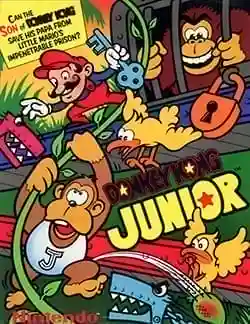
Donkey Kong Jr. is a 1982 arcade action-platform game developed by Nintendo R&D1 and published by Nintendo. It reverses the premise of the original Donkey Kong: the player controls Donkey Kong Jr. as he tries to rescue his captured father from Mario. The game combines climbing, jumping, timing, and obstacle avoidance across four repeating stages. Its single-screen layouts are simple to understand but become demanding as enemies move faster and hazards multiply. The game was well received for its colorful presentation, responsive controls, and clever role reversal, and it remains notable as Mario’s only major arcade appearance as an antagonist.
Catalog entry maintained by EmuGamers Editorial Team


Community discussion
What are players saying? 0